
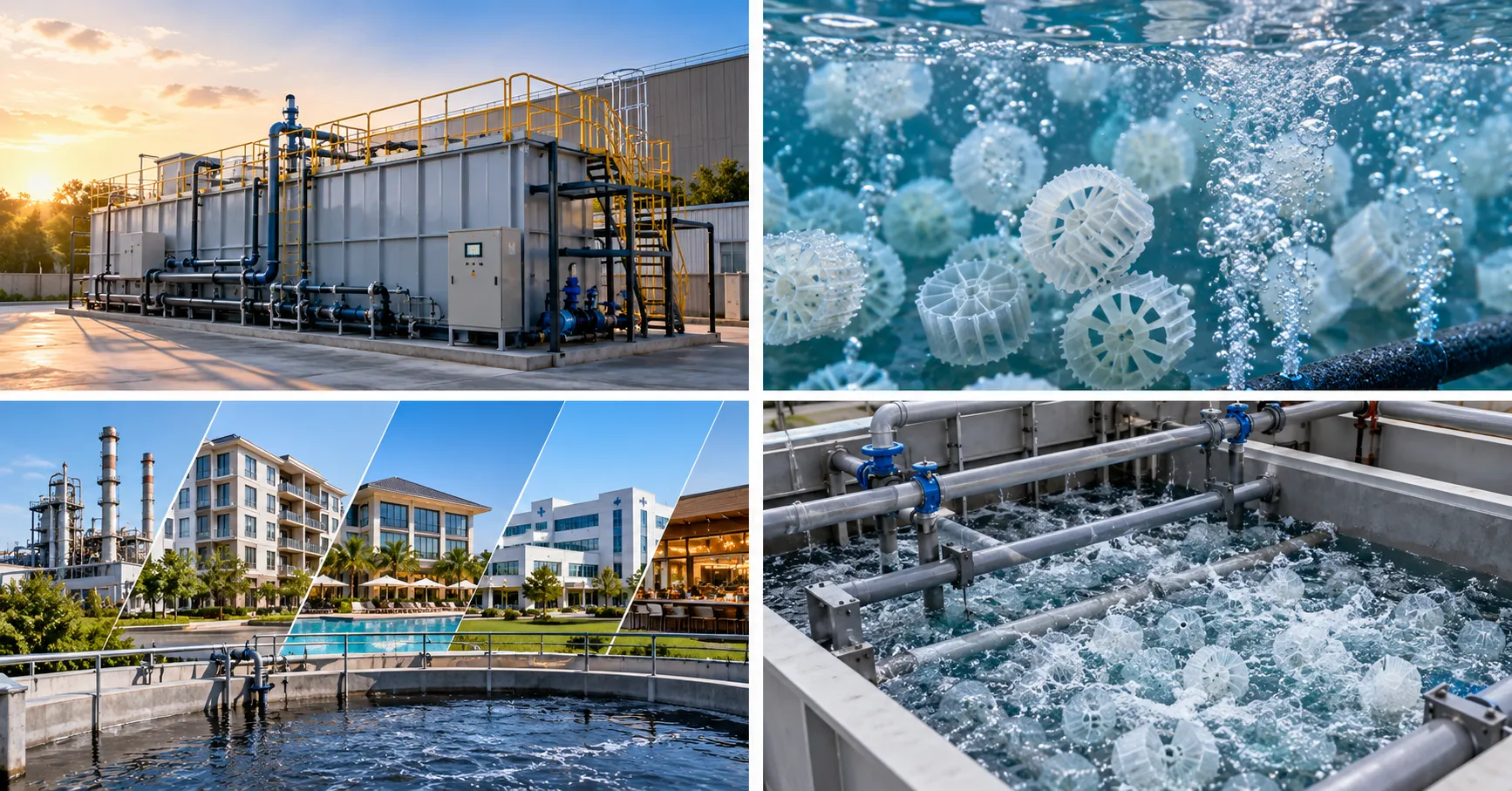
Increasing water consumption, industrial development, limited water resources, and stricter environmental requirements have made wastewater treatment an essential part of modern industrial, commercial, and residential infrastructure. Discharging untreated wastewater can lead to contamination of water and soil resources, unpleasant odors, operational problems, and significant environmental costs.
At the same time, many projects face limited available space, demanding installation schedules, or the need for a compact and reliable wastewater treatment system. Under these conditions, the MBBR wastewater treatment package offers an effective solution for biological wastewater treatment with a compact footprint and flexible configuration.
MBBR, or Moving Bed Biofilm Reactor, is a biological treatment technology that uses suspended carrier media to support the growth of microorganisms. The microorganisms form a biofilm on the surface of the media and contribute to the biological degradation of organic pollutants in wastewater. Due to its high effective surface area and compact process configuration, MBBR can provide efficient treatment performance within a relatively small footprint.

Why Is an MBBR Package Needed?
Traditional wastewater treatment systems can require considerable land area, extensive civil works, and longer construction periods. These factors may create significant challenges for factories, industrial facilities, commercial buildings, residential complexes, construction projects, and sites where available space is limited.
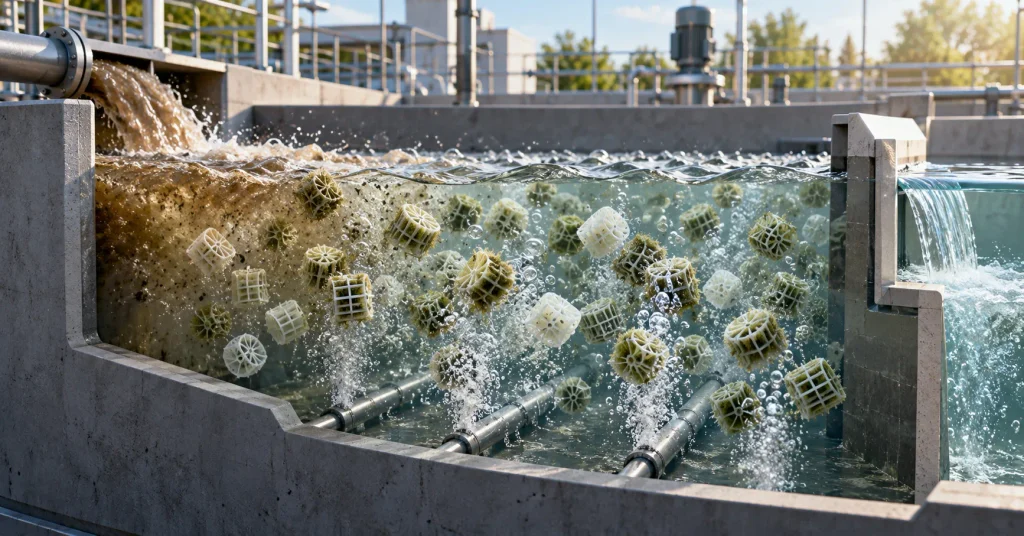
The MBBR process allows a significant portion of biological treatment to be carried out in a compact treatment unit. In an MBBR reactor, specially designed MBBR media remain suspended in the aeration tank. Their surface provides an environment for biofilm development and microbial growth.
The increased available surface area for microorganisms enables effective biological treatment without requiring excessively large reactor volumes. This makes an MBBR wastewater treatment package particularly suitable for projects where space optimization is a major consideration.
Another important advantage of a packaged system is factory-based fabrication and assembly. A large part of the equipment manufacturing and installation work can be completed before delivery to the project site. As a result, on-site installation can be simplified and the overall implementation schedule can be reduced.
This feature is especially valuable for projects where rapid commissioning, limited construction space, or minimum civil work is required.
How Does the MBBR Process Work?
The MBBR process is based on biological wastewater treatment. Wastewater enters the biological treatment stage, where aeration and mixing maintain continuous contact between the wastewater, oxygen, and suspended carrier media.
Microorganisms attached to the media consume and biodegrade organic matter present in the wastewater. Depending on the process configuration and wastewater characteristics, the system can effectively contribute to the reduction of parameters such as BOD, COD, and TSS.
When required, additional treatment stages such as clarification, filtration, sludge separation, disinfection, or other polishing processes can be integrated with the MBBR system to achieve the required effluent quality.
However, the selection and sizing of an MBBR system must be based on actual wastewater characteristics. Parameters such as wastewater flow rate, organic loading, hydraulic fluctuations, temperature, pH, suspended solids concentration, and required effluent quality all influence the final process design.
Therefore, a properly engineered industrial wastewater treatment package should not be considered a one-size-fits-all product. The package should be designed according to the specific requirements of each project.

Applications of MBBR Wastewater Treatment Packages
One of the key advantages of MBBR technology is its wide range of applications. Depending on the wastewater characteristics and treatment objectives, MBBR packages can be used for both industrial wastewater treatment and domestic or sanitary wastewater treatment.
Industrial Plants and Manufacturing Facilities:
Many industrial facilities generate wastewater containing significant organic loads and require reliable biological treatment. MBBR can be used as the main biological treatment process or as part of a complete industrial wastewater treatment system.
Residential Complexes and Building Projects:
For residential developments where connection to a centralized sewer system is not available or local wastewater treatment is required, an MBBR package can provide a practical solution for domestic wastewater treatment.
Hotels, Resorts, and Hospitality Facilities:
Hotels and hospitality facilities often experience fluctuations in wastewater flow due to variations in occupancy. A properly designed packaged wastewater treatment system can provide a flexible and manageable treatment solution.
Hospitals and Healthcare Facilities:
Wastewater generated by healthcare facilities requires careful treatment planning. MBBR can be incorporated into a complete treatment system together with appropriate pretreatment and disinfection units, depending on project requirements.
Restaurants, Industrial Kitchens, and Food Facilities:
These facilities commonly produce wastewater containing significant concentrations of fats, oils, and grease. In such applications, appropriate pretreatment—such as an industrial grease trap—can be installed upstream of the biological treatment process before the wastewater enters the MBBR reactor.
Construction Camps, Worksites, and Temporary Facilities:
The prefabricated nature of MBBR packages makes them suitable for temporary projects, construction camps, remote sites, and facilities where permanent infrastructure is not available. Certain package configurations can also be designed for relocation when required.
Wastewater Treatment Plant Expansion and Upgrading:
MBBR is not limited to new wastewater treatment projects. It can also be considered for capacity expansion and performance upgrades of existing wastewater treatment plants, depending on the existing process configuration and project objectives.
Key Advantages of MBBR Wastewater Treatment Packages
One of the most important advantages of MBBR technology is the high treatment capacity relative to the required footprint. Other benefits include compact design, flexible configuration, scalability for different capacities, suitability for various wastewater conditions, and integration with mechanical and electrical equipment.
MBBR packages can be manufactured as prefabricated steel units, polyethylene wastewater treatment packages, or other customized configurations depending on project requirements.
The system can also be equipped with aeration systems, blowers, diffusers, pumps, control panels, instrumentation, sludge handling equipment, and additional treatment stages where required.
Because the system is designed as a packaged unit, it can offer advantages in terms of transportation, installation, commissioning, and overall project execution.

